Introduction
Test results for this benchmark run →
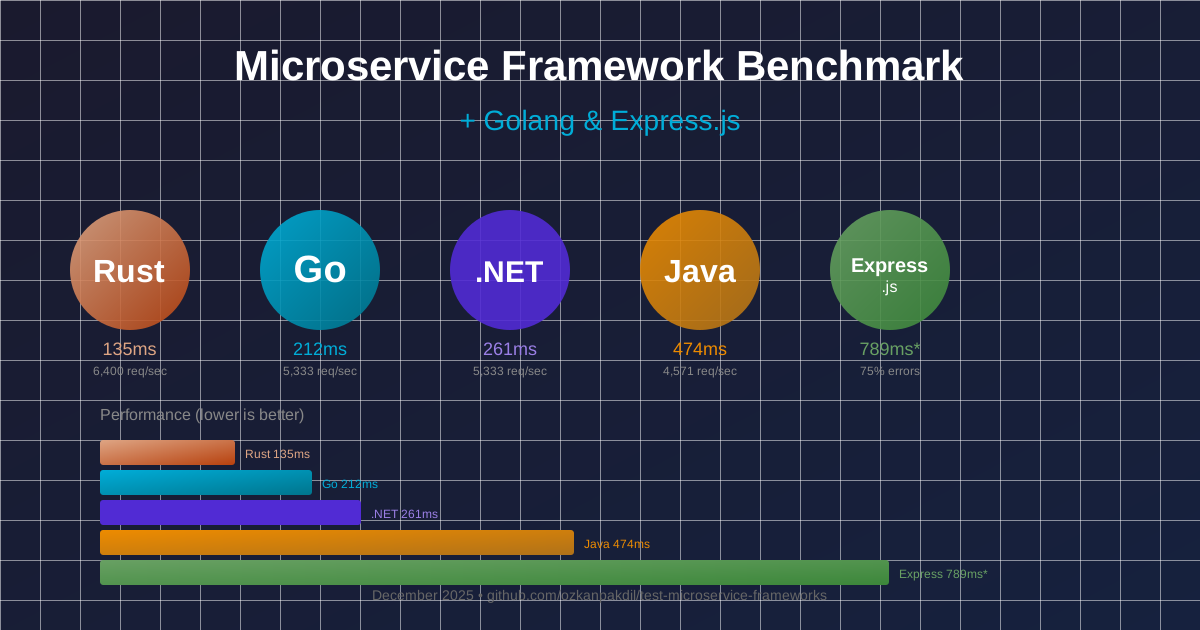
Over the last two days, I’ve expanded our microservice framework benchmark suite to include two new contenders: Golang and Express.js. This addition allows us to compare performance across a broader spectrum of technologies, from compiled languages like Rust and Go to JVM-based frameworks and Node.js.
New Additions
Golang (Go 1.24.10)
Go was added using the standard library only - no external frameworks. The implementation uses net/http package which is known for its excellent performance and simplicity.
Implementation Details:
- Go Version: 1.24.10
- HTTP Server: Standard library
net/http - No external dependencies - pure Go implementation
- Binary size: ~7.6 MB
package main

import (
    "encoding/json"
    "log"
    "net/http"
    "time"
)

type ApplicationInfo struct {
    Name        string `json:"name"`
    ReleaseYear int    `json:"releaseYear"`
}

func helloHandler(w http.ResponseWriter, r *http.Request) {
    info := ApplicationInfo{
        Name:        "golang",
        ReleaseYear: time.Now().Year(),
    }
    w.Header().Set("Content-Type", "application/json")
    json.NewEncoder(w).Encode(info)
}

func main() {
    http.HandleFunc("/hello", helloHandler)
    log.Println("Golang server started on port 8080")
    log.Fatal(http.ListenAndServe(":8080", nil))
}
Express.js (Node.js v20.19.6)
Express.js was added using Node.js 20 with the Single Executable Application (SEA) feature, which allows bundling the application into a standalone executable.
Implementation Details:
- Express.js Version: 4.21.0
- Node.js Version: v20.19.6
- Bundler: esbuild 0.24.0
- Packaging: Node.js SEA (Single Executable Application) using postject 1.0.0-alpha.6
- Binary size: Self-contained executable
const express = require('express');
const app = express();
const port = 8080;

app.get('/hello', (req, res) => {
    const info = {
        name: 'expressjs',
        releaseYear: new Date().getFullYear()
    };
    res.json(info);
});

app.listen(port, () => {
    console.log(`Express.js server started on port ${port}`);
});
Benchmark Results Overview
The results align with expectations based on each technology’s characteristics:
Performance Ranking (by mean response time, lower is better):
| Rank | Technology | Mean Response Time (ms) | Requests/sec |
|---|---|---|---|
| 1 | Rust (Warp) | 135 | 6,400 |
| 2 | Rust (Axum) | 141 | 6,400 |
| 3 | Rust (Actix) | 171 | 6,400 |
| 4 | Rust (Rocket) | 191 | 5,333 |
| 5 | Golang | 212 | 5,333 |
| 6 | .NET 8 AOT | 261 | 5,333 |
| 7 | .NET 9 AOT | 285 | 5,333 |
| 8 | .NET 7 AOT | 353 | 5,333 |
| 9 | Java Robaho | 474 | 4,571 |
| 10 | Express.js* | 789 | 2,667 |
| 11 | Micronaut | 823 | 3,556 |
| 12 | Avaje Jex | 854 | 2,133 |
| 13 | Ktor | 920 | 1,684 |
| 14 | Vertx | 1,019 | 4,000 |
| 15 | Quarkus | 1,133 | 3,200 |
| 16 | Spring Boot Web | 1,238 | 2,909 |
| 17 | Spring WebFlux | 1,279 | 2,462 |
| 18 | Kumuluz | 1,384 | 2,667 |
Key Observations
Golang Performance
Golang delivered excellent results with a 212ms mean response time and 5,333 requests/sec, placing it:
- Just behind the Rust frameworks
- Ahead of all .NET versions
- Significantly faster than all JVM-based frameworks
This performance comes from Go’s efficient runtime, goroutine-based concurrency model, and the highly optimized standard library HTTP server. The fact that we achieved these results with zero external dependencies is impressive.
Express.js Performance and Stability Issues
Express.js showed 789ms overall mean response time, but this number is misleading due to severe stability issues under load.
Critical concern: Express.js had a 75% failure rate - out of 32,000 total requests, 24,000 failed (KO) and only 8,000 succeeded (OK). For successful requests only, the mean response time was actually 3,137ms. This is dramatically worse than all other frameworks in our test suite, which typically show 0 KO (failed) requests. The successful request rate was only 667 requests/sec compared to Golang’s 5,333 requests/sec.
The errors could be attributed to:
- Single-threaded nature of Node.js - Under heavy concurrent load, the event loop can become saturated
- Connection handling limits - Default configuration may not be optimized for high concurrency
- SEA packaging - The experimental Single Executable Application feature might have some performance implications
- Memory pressure - Node.js garbage collection under load
Technology Stack Comparison
Performance Tiers:

🥇 TIER 1 (< 250ms): Rust frameworks, Golang
   - Native compilation, minimal runtime overhead

🥈 TIER 2 (250-500ms): .NET AOT, Java Native (Robaho)
   - AOT compilation benefits, optimized runtimes

🥉 TIER 3 (500-1200ms): Micronaut, Ktor, Avaje, Vertx, Express.js, Quarkus
   - JVM frameworks with varying optimizations
   - Node.js with event-driven I/O

🏅 TIER 4 (> 1200ms): Spring Boot, Kumuluz
   - Full-featured frameworks with more overhead
Build and Packaging Details
Golang Build
CGO_ENABLED=0 go build -o golang-demo .
Simple, fast compilation producing a statically linked binary.
Express.js Build (Node.js SEA)
npm install
npx esbuild main.js --bundle --platform=node --outfile=bundle.js
node --experimental-sea-config sea-config.json
cp $(command -v node) expressjs-demo
chmod 755 expressjs-demo
npx postject expressjs-demo NODE_SEA_BLOB sea-prep.blob \
    --sentinel-fuse NODE_SEA_FUSE_fce680ab2cc467b6e072b8b5df1996b2
Multi-step process to create a self-contained executable from Node.js application.
Conclusion
The addition of Golang and Express.js to our benchmark suite provides valuable insights:
Golang proves to be an excellent choice for high-performance microservices, offering near-Rust performance with a gentler learning curve and excellent developer experience.
Express.js delivers acceptable performance for many use cases but shows stability concerns under heavy load. For high-throughput scenarios, consider alternatives like Fastify or native solutions.
The performance hierarchy is now clearer:
- Rust remains the king of raw performance
- Golang is a strong second, offering excellent performance with simpler tooling
- .NET AOT continues to impress with its performance improvements
- JVM frameworks with native compilation (GraalVM) can approach .NET performance
- Node.js/Express.js is viable for moderate loads but may struggle under extreme concurrency